
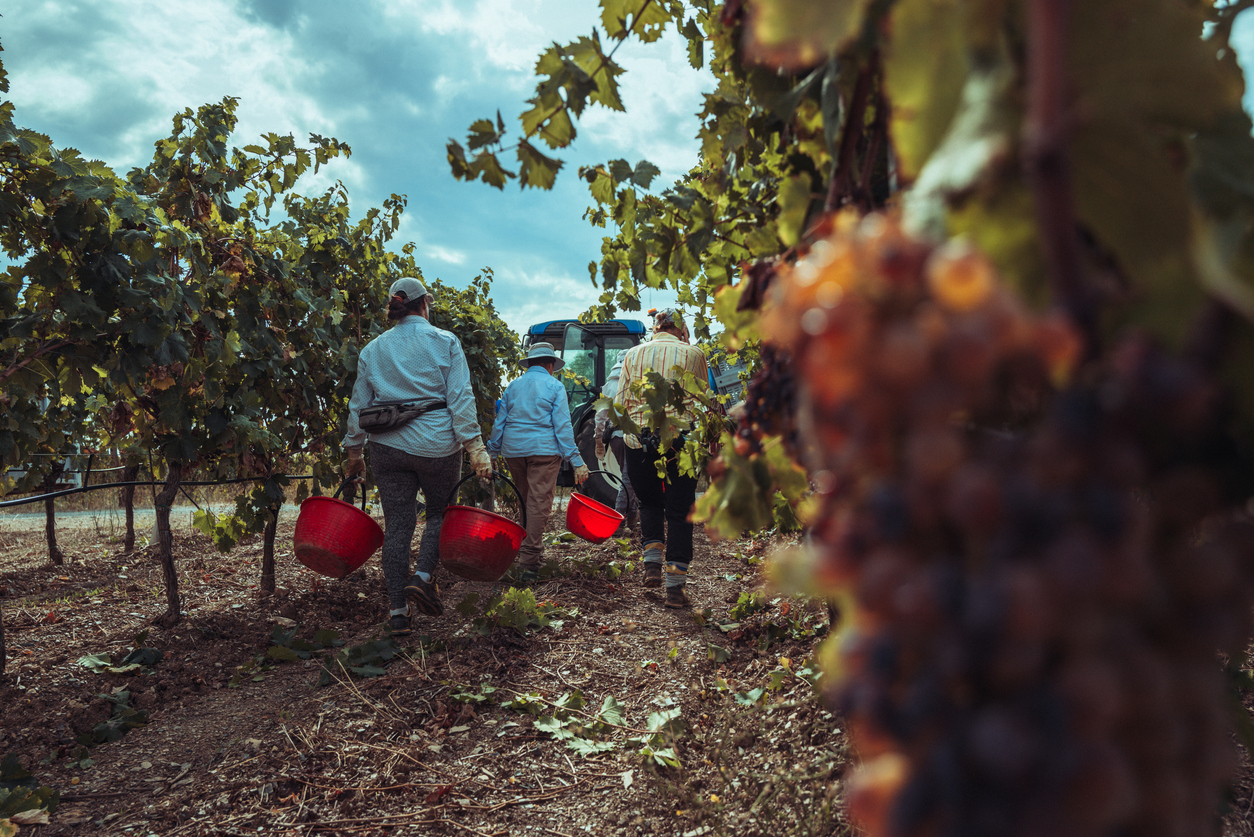
Una cosecha excepcionalmente temprana y difícil de 2026 está obligando a las regiones vinícolas a replantear cómo cultivan las uvas en un clima cambiante. Kathleen Willcox explora cómo los productores están adaptando viñedos, variedades y reglas establecidas para prepararse para un futuro cada vez más impredecible.
The 2026 vintage is garnering headlines for all of the wrong reasons. After a spring of grape-destroying hail and frost caused losses of up to 90% in regions of the US and France, harvest kicked off weeks ahead of the “normal” schedule in France, California, Spain and Italy, with very little to show.
The French Ministry of Agriculture is forecasting the lowest production levels in 70 years, and California growers are expecting, in some cases, 50% less than usual.
Amid record-low wine consumption levels, a micro yield is causing less concern than it would have 10 or 20 years ago, but vintners are concerned that climate change is becoming, instead of just a perennial problem, an existential crisis.
Julien Brustis, winemaker and CEO at Château Tour des Termes in Saint-Estèphe, explains that while he, like many of his colleagues, looks to the past for inspiration, current and future conditions require a shift in mindset and approach.
“We look at what made Bordeaux great in the past, but we’re not trying to recreate the past,” Brustis explains. “We use today’s knowledge to think about what will make Bordeaux great in 2055. And the rule behind it is quite simple: no compromise between great wine and a better future.”
Here’s how winemakers are planning for future harvests today.
Creando equilibrio en medio de condiciones alocadas
What happens when the climate is so erratic, half of a grape cluster burns, while the other half remains unripe? These bipolar conditions are becoming the norm in regions like Piedmont, Italy, says Consorzio dell’Asti DOCG director Giacomo Pondini. The Consorzio dell’Asti includes about 6,800 grape growers and winemakers.
“We are working to support vinegrowers,” Pondini says. “This harvest was the earliest in history, and it was problematic because the clusters facing the south are burning, while the ones facing the north might not be ready. It’s hard to achieve the right acidity and balance in conditions like this.”
Pondini says they are working with growers to understand how to shade grapes with cloth and canopies, and how cover crops can contribute to a more balanced grape, even in challenging conditions.
At OVID Napa Valley, winemaker Austin Peterson says that he believes the way a vineyard is farmed “is 75% of the equation” in combating climate change, while “variety is the rest”.
“Said another way, is one row orientation and one spacing the only possible way to farm grapes for all of Napa?” Peterson asks. “How can we build adaptability into a relatively fixed system? Our approach to these goals was to plant the vineyard in several different ways to see what answers and wines revealed themselves. Specifically, we planted vineyard blocks with 7 by 4 spacing, 8 by 4 spacing with a wider trellis, 10 by 5 California Sprawl, and 8 by 8 head trained. All these new plantings were Cabernet Sauvignon and Cabernet Franc.”
Spacing, he says, determines the resources available to a vine and the canopy structure that is possible, including the canopy, trellis height and relative airflow and radiant heat each grape cluster receives.
Others are turning to trees for relief.
At Dogliotti 1870 in Piedmont, oenologist and co-owner Erik Dogliotti says they are currently replanting 18 hectares of vineyards.
“We are planting peach, chestnut, oak and other trees that are naturally present in the area around the vineyard to cool down the vines and provide shade,” Dogliotti says. “We will be doing this over several years.”
Agroforestry is an increasingly popular solution to climate change, as trees within and around vineyards have been shown to reduce temperatures of vines during heatwaves, improve soil fertility, retain water and sequester carbon.
Buscando cambios amplios en las directrices
Water is an increasingly hot topic amid rising temperatures. Historically, European appellation laws forbade or severely limited vineyard irrigation. But several have loosened up.
Even Bordeaux, one of the staunchest anti-irrigation regions, has increasingly approved emergency irrigation. This year, the INAO National Committee approved the appointment of a working group tasked with assessing how sustainable irrigation can be deployed as a tool for climate resilience.
Dogliotti, meanwhile, says he is working with other vinegrowers in the region so they can formally appeal as a group to the Ministero dell’Agricoltura to soften irrigation restrictions.
“The Consorzio presents it to the Agricultural Ministry,” he explains. “The process and timeline can vary depending on the nature and urgency of the issue. We think the situation will change. The problem is to understand how to get the water. We need, for example, more systems in place to collect rainwater.”
Expectativas de las uvas
Increasingly, more regions and producers are turning to an ever-growing array of grapes and rootstocks to stymie the effects of climate change.
PIWI and hybrid grapes, while still a tiny portion of global grape production, are increasingly being turned to for their climate resilience, adaptability and inherent resistance to heat, drought and pest pressures.
Previously unthinkable developments, like the greenlighting of Voltis plantings in Champagne, are becoming the norm. Across Germany, Austria and Italy, PIWIs are cropping up alongside traditional varieties.
Pondini says the Consorzio dell’Asti is experimenting with PIWI grapes.
“We planted an experimental vineyard three years ago, and we’ll get the first harvest this year,” he says. “We are also interested in genetic modifications, and utilising tools to turn off genes that make grapes vulnerable to certain diseases, while also allowing growers to keep traditional varieties in place.”
Others, like Adrien Duboeuf-Lacombe, deputy general manager at Les Vins Georges Duboeuf, believe in the Gamay that has defined viticulture in Beaujolais for centuries. But there are many ways, he insists, to ensure climate viability with just one grape.
“We are searching for later ripening Gamay vines,” he says, explaining that SICAREX, an applied research and winemaking centre for viticulture in Beaujolais, “has a conservatory containing more than 1,000 different Gamays. The idea is to identify, within that genetic diversity, individuals with a later vegetative cycle so that ripening does not continue to move earlier and earlier into the hottest part of the summer. Gamay is at the heart of the identity of Beaujolais. Before considering a completely different grape variety, there is enormous genetic diversity within Gamay itself.”
Other vintners are working to find forgotten, rare and close-to-extinct indigenous varieties that may have been abandoned because they weren’t ripening a century ago, when the climate was different. See: Caiño Blanco in Rías Baixas, Forcada and Pirene in Catalonia, Škrlet in Croatia, etc.
Francesca Giuggioli, oenologist at San Felice in Tuscany, says the team there is working with scientists at the University of Pisa to assess a range of white and red grapes that could be included as complementary plantings that will continue to preserve indigenous varieties.
“The goal is to always strengthen the distinctive character of our Chianti Classico,” Giuggioli says. “Many of the lesser-known native cultivars may be particularly well suited to arid conditions. And in new plantings, we select rootstocks like 110R and M series hybrids” for drought resilience.
There is no magic bullet. Instead, winegrowing amid persistent change requires a puzzle master’s ingenuity and flexibility.
“We have very diverse terroirs, so there is no single recipe,” says Brustis. “So really climate change is pushing us towards more precise matching between grape variety and terroir, not simply replacing one grape with another.”
The climate is changing; harvest is changing. Farming and winemaking need to change. But the quest for greatness among ambitious winemakers? As eternal and unwavering as ever.